Robot Learning — TRLC-DK1
The idea
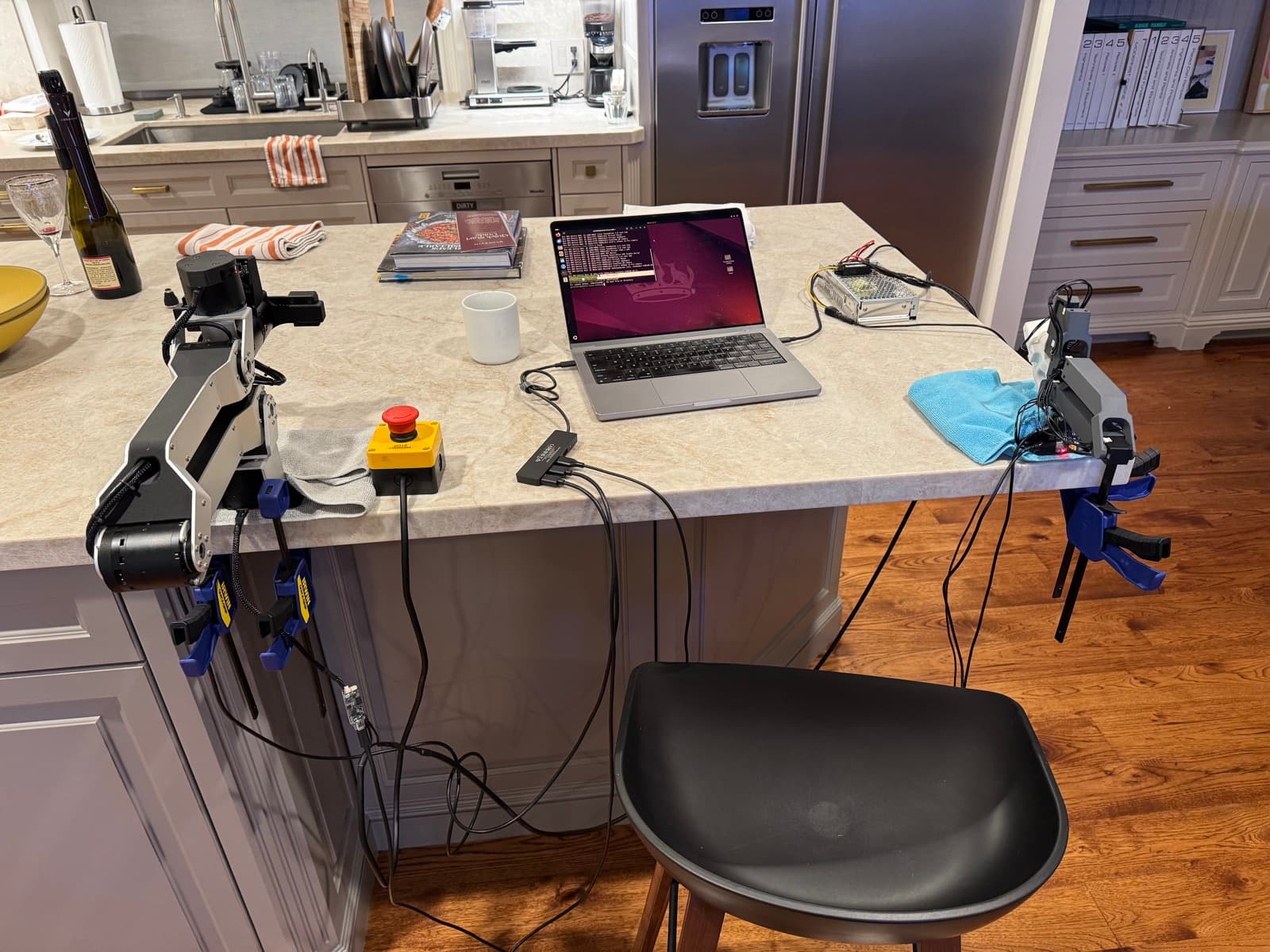
This is the project I'm most excited about right now. In January 2026 I got my hands on a TRLC-DK1, an open-source robot arm from The Robot Learning Company, a YC-backed startup, built around Hugging Face's LeRobot ecosystem. I'd been looking for a serious platform to start exploring the intersection I care about most, physical robotics and AI, and this was exactly the piece of hardware to do it on.
Learning to teleoperate
I started where everyone should, with teleoperation. The DK1 is a leader-follower setup: you move a leader arm by hand and the follower mirrors it in real time. It sounds simple, but it's the foundation for everything else, both a way to understand the hardware and, more importantly, the way you collect demonstration data to train policies later.
I spent my first weeks here, learning the mechanics of teleoperation and getting fluent with LeRobot's teleoperate and recording commands. I also went a level deeper than basic position control, moving to an impedance controller with gravity compensation for smoother, safer, more compliant motion, and eventually adding Cartesian control so I could drive the end-effector directly in space.
My first training run: ACT
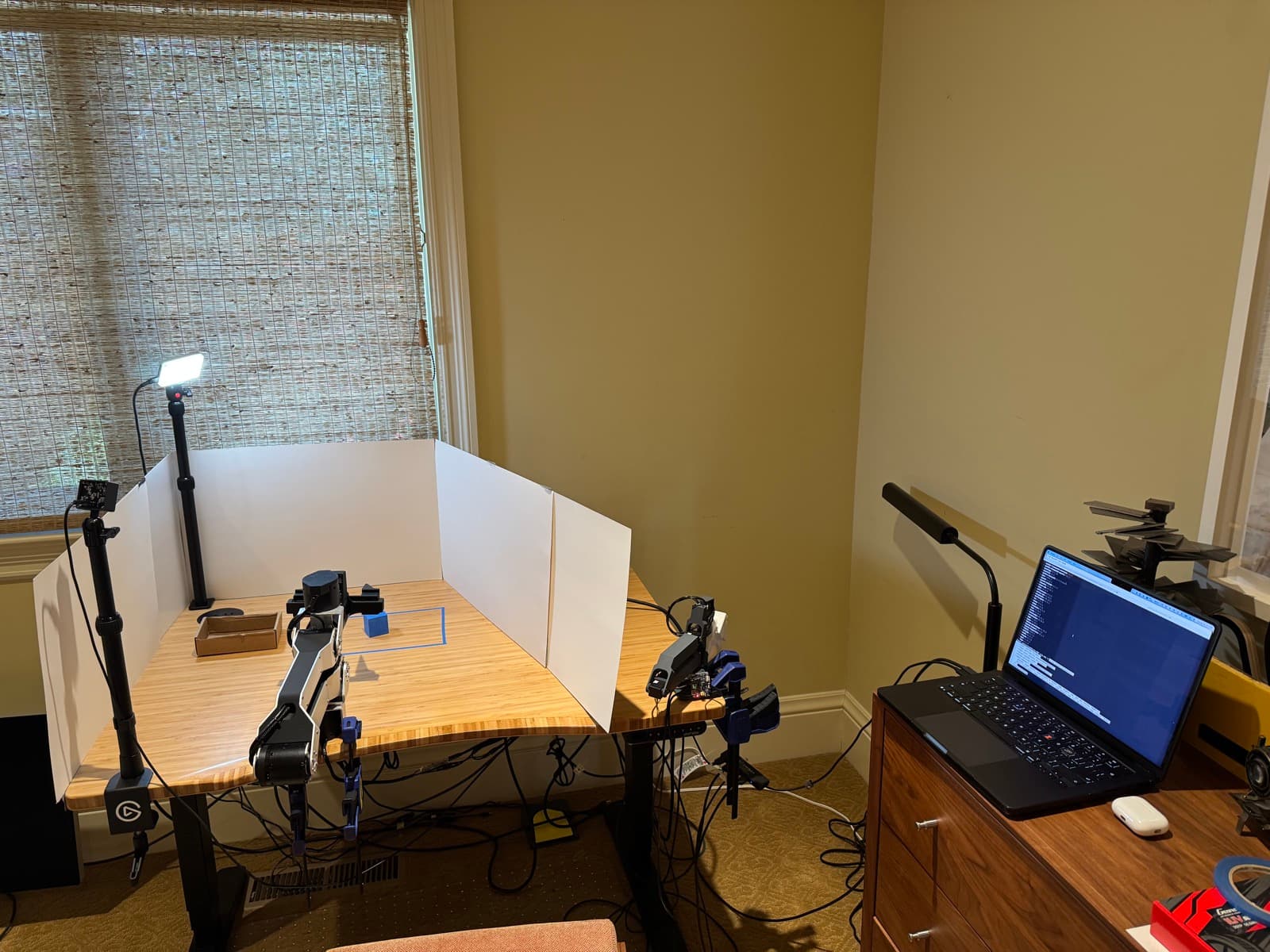
Teleoperation isn't just for driving the arm by hand, it's how you teach it. To collect a dataset, I teleoperated the DK1 to pick up a blue cube and place it into a cardboard box, over and over for about an hour, recording every episode. Then I trained my first real policy on it: an ACT model, or Action Chunking Transformer.
ACT (introduced by Zhao et al. at Stanford, out of the ALOHA project) is a clever answer to a core problem in imitation learning. Instead of predicting the next single action at every timestep, ACT predicts a whole chunk of future actions at once. That shrinks the effective decision horizon by 20 to 50 times, which cuts down the compounding errors that plague step-by-step imitation and produces noticeably smoother, more consistent motion, all from as few as ~50 human demonstrations. Under the hood it's a conditional variational autoencoder wrapped around a transformer, learning the underlying "style" of the demonstrations rather than memorizing them.
Since my laptop is for control and inference, not heavy training, I spun up a cloud GPU (an A10 on Lambda) for my first real training run, my first time renting compute to train a model from my own robot data.
What's next this summer
This is where I'm spending my summer, and the roadmap goes well beyond a single ACT policy:
- Vision-language-action models with SmolVLA. SmolVLA is a compact (450M-parameter) open VLA from Hugging Face that takes in camera views, the robot's state, and a natural-language instruction, then generates the actions to carry it out. The goal is a language-conditioned version of my task, telling the arm to "pick the red block" and having it do exactly that.
- A public dataset. Cleaning up and publishing my recordings as a LeRobotDataset on the Hugging Face Hub, contributing back to the same community data pool these models are trained on.
- A sim-to-real experiment. Training in MuJoCo and transferring to the real arm, where the interesting part isn't a perfect success rate but characterizing exactly where and why the reality gap shows up.
More than any single result, what I want out of the summer is fluency in the modern robot-learning stack, from classical kinematics, through imitation learning, to vision-language-action models, on real hardware that I've driven myself.